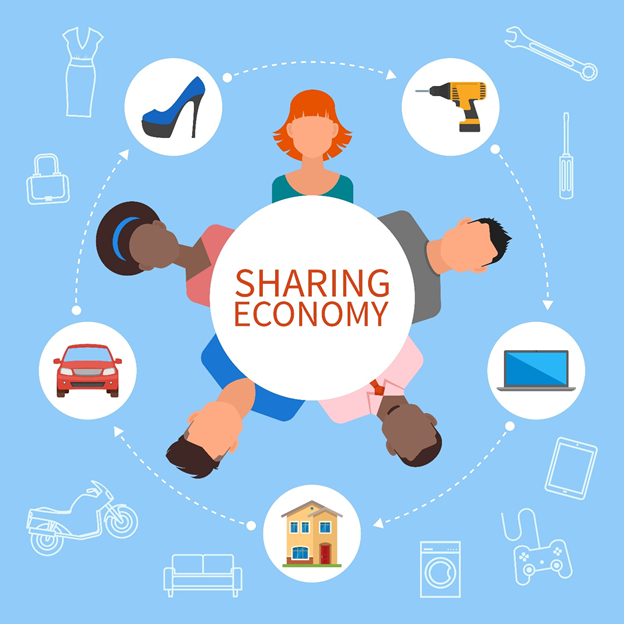
The sharing economy is defined as a way of distributing goods or services in a way that differs from the traditional model in that the resource is often shared peer-to-peer or amongst peers sometimes through a commercial intermediary. The sharing economy is also known as the access economy as in many cases the people doing the “sharing” don’t even have to know each other but are willing to pay to access someone else’s good or services. There are a number of companies that facilitate sharing of almost anything from consumer goods to parking spaces. Some commonly known companies that operate in the travel space are Uber and Lyft in ride sharing, and Airbnb in house sharing. There is even flight sharing and carpooling apps. Not all companies follow this same peer to peer model. Zipcar allows sharing of a vehicle that they own, and Lime offers shared scooters owned by the company.
Companies operating in the sharing economy, have faced enormous pushback from providers of traditional services such as taxis and hotels which can be threatened as customers choose to move their business away from traditional businesses. Though I can understand that there are a number of considerations in each of these situations such as safety, regulations, taxes etc., I do feel that businesses have to be willing to adapt to changes in consumer preferences and these companies are better suited in some cases to give the customer what they want and thus should be rewarded for their innovation.
One of the reasons that I am interested in the sharing economy is because in many cases I think it is not only good for the pocketbook but good for the environment. Some people may no longer need to own their own vehicle because they can rent one for a short period, or reliably get a ride share. In some towns, mine included people who might have driven or taken a ride share somewhere in town, are riding electric scooters, that they leave at their destination for the next rider to pick up. House sharing uses significantly less water and electricity than a hotel stay where rooms are cleaned and stocked with linens and single use amenities on a daily basis.
In addition to the natural tendency for shared goods to be more sustainable, I think there is enormous potential for companies operating in these spaces to push the envelope and that this could be a key differentiator for businesses that competing in this space. Uber offers UberXL for larger groups and should offer an UberGreen option for electric cards and hybrids. Airbnb offers Airbnb Luxe for luxury homes and should be offering an AirbnbEco for homes that meet certain green standards. With minor tweaks to the current offerings these companies could make measurable, reportable reductions in their environmental impacts while giving their customer the choice to opt in, and their providers financial incentives for doing the right thing.
How do you feel about the sharing economy? I would love to hear your thoughts and comments.

 Sabrina Siino's Sustainable Travel Blog